

 Howei Calendar
 Events Results
 Media Gallery
 Runfluencer Program
 Announcements
 Howei Helpdesk



Bicycle Tire & Tube Sizing Systems
Now there comes a time in your cycling life where you will have to change or replace your existing bike tubes or tires.

When you do so, you may notice some numbers along the body of your tire or tube.
What do these mean? How do you ensure you get the right length and size?
Which Size Tire Fits Which Size Rim?
Bicycle tires come in a bewildering variety of sizes. To make matters worse, in the early days of cycling, every country that manufactured bicycles developed its own system of marking the sizes. These different national sizing schemes created a situation in which the same size tire would be known by different numbers in different countries. Even worse, different-sized tires that were not interchangeable with one another were often marked with the same numbers!
This page covers sizes in common use as of its writing, and a number of older sizes. Sutherland's Handbook for Bicycle Mechanics, 3rd through 6th edition, covers dozens of additional, antique sizes. The 6th edition is available on CD ROM from Sutherland's. Better bike shops will have a copy.
Traditional Sizing Systems
The traditional sizing systems are based on a measurement of the outside diameter of a tire. This would usually be measured in inches (26", 27", etc.) or millimeters (650, 700, etc.).
Unfortunately, evolution of tires and rims has made these measurements lose contact with reality. Here's how it works: Let's start with the 26 x 2.125 size that became popular on heavyweight "balloon tire" bikes in the late '30's and still remains common on "beach cruiser" bikes. This size tire is very close to 26 inches in actual diameter. Some riders, however were dissatisfied with these tires, and wanted something a bit lighter and faster. The industry responded by making "middleweight" tires, marked 26 x 1.75 to fit the same rims. Although they are still called "26 inch", these tires are actually 25 5/8", not 26". This same rim size was adopted by the early pioneers of west-coast "klunkers", and became the standard for mountain bikes. Due to the appetite of the market, you can get tires as narrow as 25 mm to fit these rims, so you wind up with a "26 inch" tire that is more like 24 7/8" in actual diameter!
A second number or letter code would indicate the width of the tire. (26 x 1.75, 27 x 1 1/4...650B, 700C...)
Does Point Seven Five Equal Three Quarters?
Note that the inch-based designations sometimes express the width in a decimal (26 x 1.75) and sometimes as a common fraction (26 x 1 3/4). This is the most common cause of mismatches. Although these size designations are mathematically equal, they refer to different size tires, which are NOT interchangeable. It is dangerous to generalize when talking about tire sizing, but I would confidently state the following:
Sheldon Brown's Law Of Tire Sizing
If two tires are marked with sizes that are mathematically equal, but one is expressed as a decimal and the other as a fraction, these two tires will not be interchangeable.
Dishonesty in Sizing
Competitive pressures have often led to inaccuracy in width measurement. Here's how it works: Suppose you are in the market for a high performance 700 x 25 tire; you might reasonably investigate catalogues and advertisements to try to find the lightest 700-25 available. If the Pepsi Tire Company and the Coke Tire Company had tires of equal quality and technology, but the Pepsi 700-25 was actually a 700-24 marked as a 25, the Pepsi tire would be lighter than the accurately-marked Coke 700-25. This would put them at a competitive advantage. In self defense, Coke would retaliate by marketing an even lighter 700-23 labeled as a 700-25.
This scenario prevailed throughout the '70's and '80's. The situation got so out-of-hand that cooler heads have prevailed, and there is a strong (but not universal) trend toward accurate width measurements.
B.S.D.
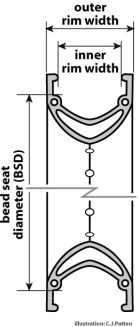
The ISO system uses two numbers; the first is the width of the tire or rim in millimeters (The actual tire width will vary a bit depending on the width of the rim. The rim width is the inner width measured between the flanges as shown in the diagram.)
The second ISO number is the critical one, it is the diameter of the bead seat of the rim, in mm ("B.S.D."). Generally, if this number matches, the tire involved will fit onto the rim; if it doesn't match, the tire won't fit.
For example, a 700 x 20 C road tire would be a 20-622; a 700 x 38 hybrid tire would be a 38-622. The width difference between these sizes would make them less-than ideal replacements for one another, but any rim that could fit one of them would work after a fashion with the other.
A general guideline is that the tire width should be between 1.45/2.0 x the inner rim width.
If you flatten out a tire and measure the total width from bead to bead, it should be approximately 2.5 x the ISO width.
If your tire is too narrow for the rim there's an increased risk of tire/rim damage from road hazards.
If its too wide for the rim, there's an increase risk of sidewall wear from brake shoes, and a greater risk of loss of control in the event of a sudden flat.
The following is a partial listing of traditional tire sizes, with their ISO bead seat equivalents. The ISO comparison list at the bottom of this page covers all sizes which we know to be in production as of 2016. The fractional, decimal and French lists cover common sizes.
Fractional sizes:
| Fractional | ISO | Applications |
|---|---|---|
| 36 inch | 787 mm | Unicycles, some novelty bicycles |
| 32 inch | 686 mm | Unicycles, some novelty bicycles |
| 29 inch | 622 mm | This is a marketing term for wide 622 mm ("700C") tires. |
| 28 x 1 1/2 | 635 mm | English, Dutch, Chinese, Indian Rod-brake roadsters (Also marked F10, F25, 700 B) |
| 622 mm | (F.13) Rare Canadian designation | |
| 28 x 1 5/8 x 1 1/4 |
Northern European designation for the 622 mm (700 C) size | |
| 27 x anything except "27 five" and 609 mm Dutch | 630 mm | Older road bikes. |
| 26 x 1 (650 C) | 571 mm | Triathlon, time trial, small road bikes. Old Schwinn S-4 |
| 26 x 1 1/4 | 597 mm | Older British sport & club bikes |
| 26 x 1 3/8 (S-6) |
Schwinn "lightweights" | |
| 26 x 1 3/8 (E.A.3) | 590 mm | Most English 3-speeds, department-store or juvenile 10 speeds |
| 26 x 1 1/2 (650B) | 584 mm | French utility, tandem and loaded-touring bikes, a very few Raleigh (U.S.) & Schwinn mountain bikes. |
| 26 x 1 3/4 (S-7) |
571 mm | Schwinn cruisers |
| 26 x 1, 1 1/8 | High performance wheels for smaller riders, common on Cannondale bicycles | |
| 24 x 1 | 520 mm | High performance wheels for smaller riders; Terry front |
| 24 x 1 1/8 | 520 mm or 540 mm! |
Caveat emptor |
| 24 x 1 1/4 | 547 mm | British or Schwinn Juvenile |
| 24 x 1 3/8 (S-5) |
Schwinn Juvenile lightweights | |
| 24 x 1 3/8 (E-5) |
540 mm | British Juvenile, most wheelchairs; common on women's utility bicycles in Japan. |
| 20 x 1 1/8 20 x 1 1/4 20 x 1 3/8 |
451 mm | Juvenile lightweights, BMX for light riders, some recumbents, some folding bicycles |
| 20 x 1 3/4 | 419 mm | Schwinn juvenile |
| 18 x 1 3/8 | 400 mm | British juvenile |
| 17 x 1 1/4 | 369 mm | Alex Moulton AM series |
| 16 x 1 3/8 | 349 mm | Older Moulton; Brompton & other folders, recumbent front, juvenile |
| 16 x 1 3/8 | 337 mm | Mystery tire |
| 16 x 1 3/8 | 335 mm | Polish juvenile |
| 16 x 1 3/4 | 317 mm | Schwinn Juvenile |
| 12 1/2 x anything | 203 mm | Juvenile, scooters |
| 10 x 2 | 152 mm | Wheelchair caster |
| 8 x 1 1/4 | 137 mm | Wheelchair caster |
Traditionally, fractional sizes are made for straight-sided rims.
High-performance sizes (520 mm, 571, 622 mm etc.) are preferably used with hook-edge rims, whichcan hold higher pressure and center the tires more reliably.
Decimal sizes:
| Decimal | ISO | Applications |
|---|---|---|
| 29 inch | 622 mm | This is a marketing term for wide 622 mm ("700c") tires. |
| 28 x decimal | Some German tire companies use this non-standard designation for 622 mm ("700c") tires. | |
| "27 five" (meaning 27.5) | 584 mm | Marketing term for wide, knobby 584 mm tires. Some Mountain bikes |
| 26 x 1.00 through 5.0 | 559 mm | Most Mountain bikes, cruisers, fatbikes etc. Old Schwinn designation was S-2 |
| 26 x 1.25 (rare) | 599 mm | Very old U.S. lightweights |
| 26 x 1.375 | Very old U.S. lightweights | |
| 24 x 1.5-24 x 2.125 | 507 mm | Juvenile mountain bikes, cruisers |
| 22 x 1.75, 22 x 2.125 | 457 mm | Juvenile |
| 20 x 1.5-20 x 2.125 | 406 mm | Most BMX, juvenile, folders, trailers, some recumbents |
| 18 x 1.5 | 355 mm | Birdy folding bikes |
| 18 x 1.75-18 x 2.125 | Juvenile | |
| 16 x 1.75-16 x 2.125 | 305 mm | Juvenile, folders, trailers, some recumbents |
French sizes:
In the French system, the first number is the nominal diameter in mm, followed by a letter code for the width: "A" is narrow, "D" is wide. The letter codes no longer correspond to the tire width, since narrow tires are often made for rim sizes that originally took wide tires; for example, 700 C was originally a wide size, but now is available in very narrow widths, with actual diameters as small as 660 mm.
| French Size | ISO | Applications |
|---|---|---|
| 700 A | 642 mm | Obsolete |
| 700 B | 635 mm | Rod-brake roadsters. |
| 700 C | 622 mm | Road bikes, hybrids, "29 inch" MTBs. (28 x 1 1/2 F.13 Canada) |
| 700 D | 587 mm | Oddball size formerly used on some GT models. |
| 650 A | 590 mm | French version of 26 x 1 3/8; Italian high-performance bikes for smaller riders |
| 650 B | 584 mm | French utility bikes, tandems, and loaded-touring bikes; some older Raleigh and Schwinn mountain bikes |
| 650 C | 571 mm | Triathlon, time trial, high performance road bikes for smaller riders |
| 600 A | 540 mm | European Juvenile road bikes, most wheelchairs |
| 550 A | 490 mm | European Juvenile road bikes |
| 500 A | 440 mm | European Juvenile, folding |
| 450 A | 390 mm | European Juvenile |
| 400 A | 340 mm | European Juvenile |
ISO Cross Reference:
| ISO Bead Seat Diameter | Traditional Designations |
|---|---|
| 787 mm | 36 inch |
| 686 mm | 32 inch |
| 635 mm | 28 x 1 1/2, 700 B |
| 630 mm | 27 x anything except "27 five" and 609 mm |
| 622 mm | 700 C, 28 x (two fractions), 29 inch, 28 x 1 1/2 F.13 Canada |
| 609 mm | Rare Dutch size, 27 x 1 1/2 |
| 599 mm | 26 x 1.25, x 1.375 -- old US size |
| 597 mm | 26 x 1 1/4, 26 x 1 3/8 (S-6) |
| 590 mm | 26 x 1 3/8 (E.A.3), 650 A |
| 587 mm | 700 D -- oddball size made by GT |
| 584 mm | 650B, 26 x 1 1/2, "27 five" |
| 571 mm | 26 x 1, 26 x 1 3/4, 650 C |
| 559 mm | 26 x 1.00- x 2.125, also fatbike tires up to 5 inches wide |
| 547 mm | 24 x 1 1/4, 24 x 1 3/8 (S-5) |
| 541 mm | 600 A |
| 540 mm | 24 x 1 1/8, 24 x 1 3/8 (E.5), |
| 520 mm | 24 x 1, 24 x 1 1/8 |
| 507 mm | 24 x 1.5- x 2.125 |
| 501 mm | British, 22 x 1 3/8, 22 x 1.00 |
| 490 mm | 550 A |
| 489 mm | Dutch juvenile 22 x 1 1/8 NL, 22 x 1 3/8 NL |
| 484 mm | 550 B |
| 457 mm | 22 x 1.75; x 2.125 |
| 451 mm | 20 x 1 1/8; x 1 1/4; x 1 3/8 |
| 440 mm | 500 A |
| 438 mm | Dutch juvenile, 20 x 1 3/8 NL |
| 428 mm | Swedish, 20 x 2 |
| 419 mm | 20 x 1 3/4 |
| 406 mm | 20 x 1.5- x 2.125 |
| 390 mm | 450 A |
| 369 mm | 17 x 1 1/4 |
| 355 mm | 18 x 1.5- x 2.125 |
| 349 mm | 16 x 1 3/8 |
| 340 mm | 400 A |
| 337 mm | 16 x 1 3/8 |
| 317 mm | 16 x 1 3/4 |
| 305 mm | 16 x 1.75- x 2.125 |
| 288 mm | 350 A |
| 254 mm | 14 x 1.75 |
| 203 mm | 12 1/2 X anything. |
| 152 mm | 10 x 2 |
| 137 mm | 8 x 1 1/4 |